What the Desert Does With Children Nobody Is Looking For
or: What the Books Are For

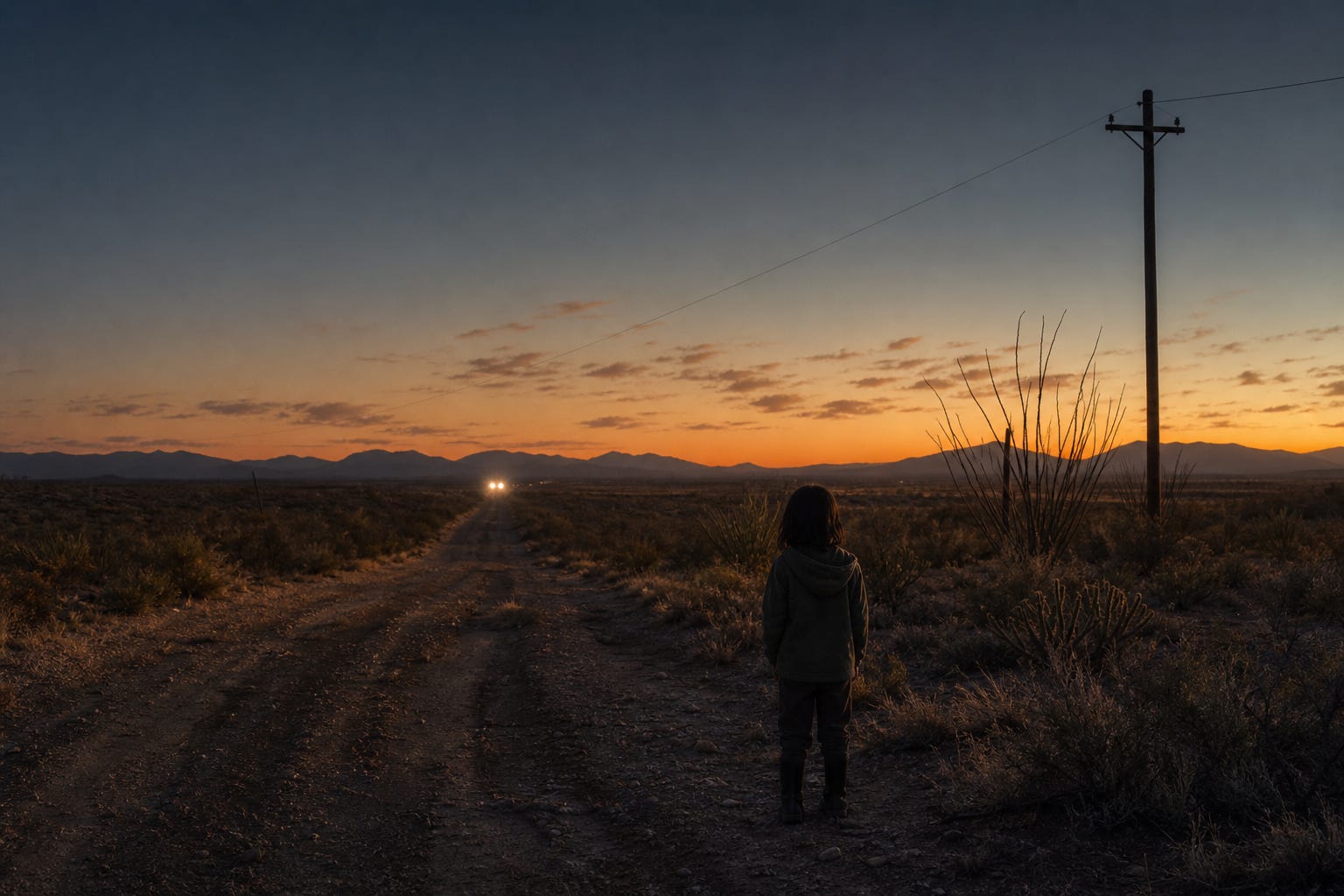
I was watching Abigail (2024) the night the news was running its border count.
The film puts one little girl in one room with the men who kidnapped her. The news puts a number on a chyron. Both of those things were on screens in the same house at the same time, and the disconnect between them was the loudest thing in the room.
The film knew her name. The news knew the count.
The question that arrived in the gap is the one the series I have spent the last year writing exists to answer. Not where the children crossed. The desert is full of crossings. The desert has been full of crossings since long before there was a wire. The question is where they went after, and what was waiting for them, and what got made of the ones nobody came looking for.
That question doesn’t have a journalism shape. Journalism counts. It has to count. The instrument is calibrated for scale, and scale is what tells the public a thing is happening. But scale erases the individual by definition. A specific child in a specific situation does not survive being summed.
Horror fiction can witness what the count cannot.
The Pipeline
Vampires of Tucson is set in the Sonoran borderland that I can see from my back door. Hereford, Arizona. The Huachuca Mountains stand up off the floor of the valley about three miles south of where I am writing this. Highway 92 runs out of Sierra Vista, past my house, down to Palominas. Mexico just a few thousand meters to the south. None of this geography is abstract to me. The border is a feature of the room, the way a furnace is.
The series has eleven novels in the architecture and three of them are written. There is a coterie in the books called the Hollow Saints. They run a pipeline.
What the pipeline does is take the children whose disappearance into the desert was already a foregone conclusion. The ones the cartel is moving north because there is a market for them. The ones the smugglers were going to abandon when the heat turned bad. The ones the world had already decided not to look for.
What they do with them is the engine of the series. The cartel was going to consume the children one way. The Hollow Saints intercept and consume them another. The same child was going to be destroyed in either ledger.
In the supernatural one, the destruction takes a specific shape. The child is Turned, sometimes by force, sometimes through engineered desperation, always before the child has any meaningful capacity to refuse. The Hollow Saints get a recruit. The recruit gets a kind of survival the survivor will spend the rest of their unending existence trying to pretend was a choice.
Most of the children do not survive the Turning. Most of them go feral. The ones who go feral become something the books call Rabids: blood-mad, uncontrollable, broken in a way that even the supernatural cannot file.
The Hollow Saints know this. They have done the math. They know the success rate is low. They run the pipeline anyway, because the failures are the weapon.
The Rabids do not get put down. The Rabids get released. Across population centers. Across the country.
The Hollow Saints are eschatologists. They are working toward the world Daybreakers (2010) started with: a managed cattle-world after the calculus has already shifted. The Rabids are how you shift the calculus. Burn down enough cities and the survivors stop pretending the supernatural was always rumor.
That is what the pipeline does before what it is called.
Why the Children Most Likely to Survive the Turning Are the Ones Who Were Already in Hell
There is a specific cruelty in the math here.
A vampire’s first night of undeath is, at the level of the brain, an environmental catastrophe. Sensory input arrives wrong. The heart is no longer running. The hunger, when it lands, is not the hunger anyone has language for. The mind that survives this is the mind that already had infrastructure built for surviving things it did not have language for.
CPTSD comes pre-installed with that infrastructure. A brain that has spent ten years learning to absorb input from a hostile environment without breaking is a brain that has the on-paper requirements for the Turning. Hyper-vigilance, dissociation, the trick of going somewhere else for a while when the body is being asked to be somewhere it cannot bear. Those are not deficits in this context. They are the calibration the Turning requires.
The children most likely to survive the Turning are the ones for whom surviving had already stopped feeling like winning.
That is the engine. Not resilience. Not strength. The shape of damage so complete that it erased the reference point.
The silence of undeath is not new to a mind that was already running on internal systems built for exactly that silence. The trauma did not produce a hero. The trauma produced a survivor who is now extremely useful to the people who broke her, and the people who broke her went looking for that exact combination on purpose.
The cartel curates the supply. The Hollow Saints curate the cartel.
What Fiction Can Do That the Count Cannot
I have an interior in the books called the Bureau of Internal Affairs. It is the rendered psychological architecture of a specific character at the moment of her Turning. Babydoll. Eighteen years old. Sold herself to the cartel to escape the incest at home, trafficked to Nogales, Turned in the desert after one of the Hollow Saints noticed her.
The Bureau is what is happening inside her head while the outside of her is being killed and rebuilt.
It is a waiting room. Fluorescent lights, beige walls, an intercom. The Vampire “demon” arrives, the way the demon arrives in vampire fiction, declaring its rage and its hunger and its appetite for the world. The demon takes a number.
The clerks at the windows are running the same forms they have always run. The mirror thing, the priest’s denial, and the zip-ties. The demon slumps in a plastic chair. Outside, the world continues without incident. Inside, the apocalypse sits in a waiting room, listening to the hum of the lights.
That is two and a half pages in a manuscript. It is not a metaphor I built for an article. It is canon infrastructure in a novel. It is the inside of a specific named girl on a specific named night, rendered with enough precision that the reader cannot read it and walk away counting.
The news cannot do that. It is not the medium’s failure. It is the medium’s job. The count is the count. It is the instrument.
But the count is also the totality of what most of the public ever sees of the children whose names will not survive their crossing. They get added. They become a number that can be argued about on a panel show or in a White House briefing or on a chyron, and the number is the obituary that does not name the dead.
Fiction can name them. Fiction can render the specific weight of the specific child. Fiction can put a reader inside a particular waiting room on a particular night and refuse to let them count their way out.
That is not a craft trick. That is the formal capacity of the instrument.
Witness vs. Spectacle
There is a category of horror writing that uses suffering as material the way a chef uses stock. The premise is suffering. The plot is what suffering does to the people it lands on. The reader is invited to consume the spectacle and close the book having had a feeling. That category exists. I am not writing in it.
The distinction is witness and consumption. Witness names the specific weight. Consumption renders the spectacle and pockets the feeling. Witness leaves the reader different than it found them. Consumption leaves the reader exactly where they started.
This is also why the Hollow Saints are not monsters in the books. A monster story absolves everyone. Monsters are unaccountable. The Hollow Saints are people.
La Dama Roja was a trafficked dancer once. Her abilities came out of the way she learned to perform survival under coercion. She is a survivor who decided what to do with what was left of her after, and the deciding is the horror. They are unforgivable not because they are the wrong kind of thing but because they are still people, still capable of choosing otherwise, and they don’t.
Vampires were the only frame I had that could carry the weight of what is actually happening, because the metaphysics of the Turning let me render the specific, named horror of a specific, named child without scale-washing. The vampires are the instrument. The children are the subject. The pipeline is the witness.
There is also a deep-black government program in the books, called PALE HORSE, that knows all of this and classifies it. That is the spine of a different article. What it means here is that the children disappear into two filing systems, the metaphysical and the bureaucratic, and neither one is looking for them.
The Close
Here is what the books are arguing, said plain.
The Hollow Saints are people. They are people who chose children that the world had already taught Life was not for them, and they made that lesson permanent. The choice was a choice. Each member of the coterie made it, and made it, and made it. None of them had to. They did anyway.
There was a child (in 2024) at a threshold somewhere on a road south of where I am writing this. She had not yet made the choice between the three modes a Turned mind had available to it: turning her back on the living, becoming obsessed with returning, becoming obsessed with destroying what she can no longer have. She had not made it because the choice was made for her. By people. By name. On a specific night that the news did not cover.
There is a stamp on a file in a building she will never see, classifying her. Same child. One disappearance is metaphysical. One is bureaucratic. Both filing systems are working as designed. Neither one is looking for her.
That is what the desert does with children nobody is looking for.
That is what the books are for.
You may also like: