Trauma and You...
or, how to write trauma-damaged characters authentically

A traumatized character in most fiction breaks down on cue and recovers on schedule, building toward a resolution that delivers the audience a feeling and the character an arc. That’s tidy. It’s also not how trauma works.
The science, briefly (because it changes everything)
Katheryn Greenleaf published a paper recently titled “The Neuro-Adapted Brain,” and the argument she makes should be required reading before you write a single character shaped by adversity. Her core claim: trauma doesn’t damage the brain. It reconfigures it.
The brain that survived adversity adapted. It built a survival-optimized operating system (OS), recalibrating threat detection, rewiring the networks responsible for memory and emotional regulation. The DSM (Diagnostic and Statistical Manual of Mental Disorders) catalogs the outputs under a dozen different diagnoses. Greenleaf argues they’re all the same thing: a brain doing exactly what it was designed to do.
This distinction matters more to writers than it does to clinicians. Once you understand that the behavior is logical, you stop writing trauma as malfunction. You start writing it as architecture.
The architecture needs a floor plan. Here’s one.
Greenleaf’s paper:

The Mental DMV
I wrote this vignette recently as a way of illustrating the neuroscience without using the word “hippocampus”:
Darkness. A humming light flickers overhead - pale, bureaucratic fluorescence that should not exist inside anyone’s head. The walls are beige. The floor is linoleum. A crooked sign reads: Welcome to the Bureau of Internal Affairs - Trauma Division. Please take a number.
The demon arrives like a hurricane trying to fit through a revolving door. Rage, hunger, and infinite appetite squeeze into a chair that’s too small for its enormity.
The Demon: I am rage incarnate! I am the end of hunger! I devour the sun and drink the blood of...
Clerk #1 (Frontal Lobe): Form 37B. Manifestation of overwhelming emotion, category: Existential. Fill in the box marked origin trauma.
The Demon roars, rattling the partition walls.
A second clerk appears, balancing an absurd stack of forms.
Clerk #2 (Amygdala): If you’re claiming catastrophic identity loss, we’ll also need Form 12-H - Dissociative Episodes, sub-section New Entities.
The Demon bellows again. Dust drifts from an air vent labeled Childhood.
Intercom: Yeah, yeah. Take a number. We’re still processing the zip-ties, the mirror thing, all that priest nonsense. You’ll get your turn.
A Muzak version of “Hurt” plays softly over a broken speaker.
The Demon slumps. It tries to snarl, but the echo dies in paperwork.
A rubber stamp thuds. A file drawer slides shut.
Intercom: Case logged. Category: New Normal.
Outside, the world continues without incident.
Inside, the apocalypse sits in a waiting room, listening to the hum of fluorescent lights.
That piece isn’t poetry. It’s neuroscience in a Halloween costume: the Frontal Lobe processing the intrusion, the Amygdala filing it for later reference. At the end, the apocalypse sits down and waits. Not because it’s defeated, but because that’s what a survival-optimized brain does.
It doesn’t combust. It files the paperwork and keeps running. What walks out of that waiting room isn’t broken. It’s built. Trauma did the building. What it built we will discuss in the next section.
What the OS looks like on the page
I can say with authority that once the brain adapts, you aren’t going back to the original OS. You have been upgraded, for good or bad, to the new and improved version.
The upgrade to the OS also includes new built in features provided by the trauma that you would not have requested:
Hyper-vigilance: an accurate and tireless threat model running in the background of every room you walk into.
Hyperarousal: exaggerated startle response, persistent sleep disruption. The threat model doesn’t clock out at night.
Intrusive memory: files retrieved without user request, triggered by sensory input you didn’t know was tagged.
Avoidance: automatic routing around anything flagged threat-adjacent, regardless of whether the original threat still exists.
Freeze response: the third option that doesn’t appear on the fight-or-flight brochure. The system locks. Waits. Survives.
Fawning: learned appeasement behavior. Threat neutralized through compliance rather than confrontation. Common in chronic and developmental trauma.
Emotional dysregulation: intensity calibrated for a previous environment. Fires in the present. Returns to baseline slowly.
Shame architecture: not guilt about specific behavior. A standing conviction about your own existence. Pre-installed, not earned.
Attachment disruption: expects abandonment. Sometimes causes it, to confirm the model was correct all along.
Somatic storage: the body logs what the mind can’t process. Retrieves it later. Physically.
Dissociation: brief or extended detachment from present experience. Ranges from a few-second absence to extended periods of unreality.
There’s no uninstall. No save point. The brain that predates the adaptation is gone, and the one that replaced it runs differently. This isn’t malfunction. It’s specification. And here is what it looks like on the page.
The character who always sits with their back to the wall isn’t being antisocial. The system is threat-scanning: automatic and completely rational given the history that built it.
The character who reads a friend’s unanswered text as abandonment isn’t being dramatic. The threat-biased schema is filling in ambiguous information with the pattern it knows: people disappear, silence means danger, warmth has a price. The calculation is wrong in this context. It was correct in a previous one.
The character who goes quiet mid-conversation and returns three seconds later like nothing happened isn’t spacy. That’s dissociation: the brief protective detachment a system engages when input becomes too loud. The character barely registers it. The people around them usually do.
The character who responds to a raised voice with cold fury rather than fear isn’t inconsistent. Fight responses come pre-installed. So does the shame afterward, arriving late, like a bill.
These aren’t scenes. They’re textures: the hundred small ways the OS runs in the background, coloring every misread signal and every decision made with incomplete data. The threat model was built years ago. It’s never been fully updated.
That’s what it looks like when it’s written honestly. Most fiction doesn’t write it that way.
The disability porn problem
“Disability porn” is a term from disability communities, and it applies here with uncomfortable precision. It refers to work that uses a character’s condition as spectacle: the breakdown exists to make the audience feel something, mostly about themselves.
The tell is instrumentality. The traumatized character breaks down when the plot needs them to, recovers when the plot rewards them for it. They were never a person. They were a pity structure with a name.
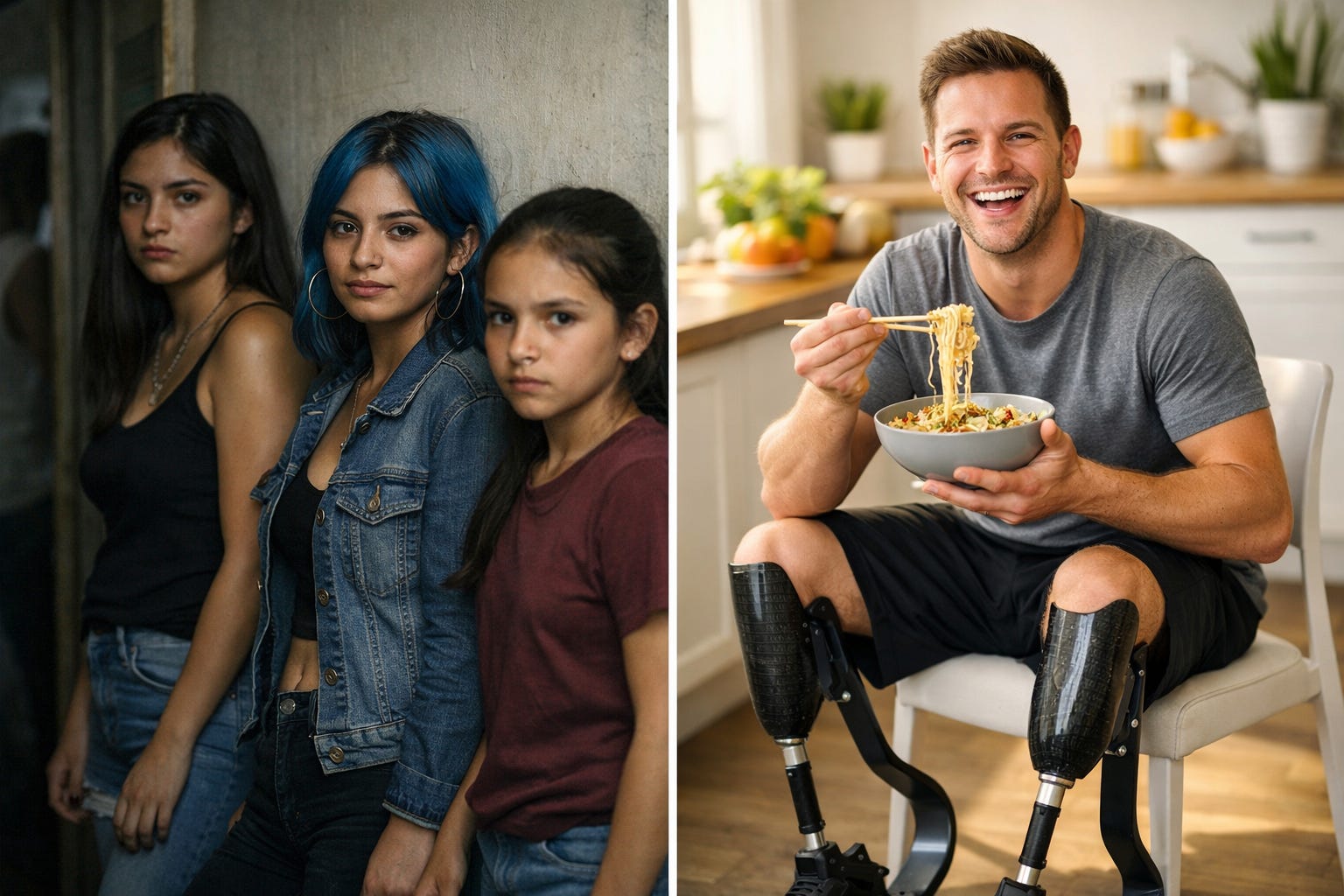
Consider Weston from 100 Days of Sunlight. He loses both legs to a staph infection requiring amputation. The author, who has never had a problem in her life short of finding high-quality waffles, gives him a warm smile and an unbroken spirit. He’s cheerful and relentlessly upbeat, and his primary function in the novel is helping the female protagonist accept her own temporary blindness.
This is the other face of the same coin. Not the character who breaks on cue, but the one who never breaks at all. The function is identical: the character exists to produce a feeling in the audience, and that feeling isn’t authentic response to a real person. It’s the comfort of watching someone else’s suffering get resolved neatly, so you don’t have to sit with what it actually costs.
Real grief doesn’t resolve on schedule. A character who lost both legs and is persistently cheerful about it isn’t inspiring. They’re a wish fulfillment device wearing the aesthetic of suffering.
There’s a quieter version that’s harder to catch: trauma as pure liability. The traumatized character is a collection of deficits. They flinch, avoid, shut down, drive people away. The narrative circles their damage and calls it depth.
Greenleaf’s framework breaks that pattern. A survival-optimized brain is also faster at threat recognition, harder to deceive, better at reading micro-expressions, less likely to accept comforting lies. It paid for those capabilities in coin most people never had to spend. That’s worth writing, too.
Trauma as an excuse for poor behavior
Twilight is the other reference case. Edward Cullen has been a vampire since 1901. A century of predatory existence should have built an OS so layered it’s geological. Instead, he’s brooding about high school and struggling to resist a girl who smells particularly good.
Edward is also one hundred and four years old. Bella is seventeen. The series presents the age gap as romantic intrigue rather than the premise of a nature documentary, which requires the reader to do a significant amount of not thinking about it.
Bella Swan is subjected to genuine trauma throughout the series. Her response to Edward leaving is a chapter sequence titled with month names to convey depression through the absence of prose. It’s aesthetically clever. It’s not how the OS works: she recovers completely when he returns, and the architecture doesn’t accumulate.
There’s also this: a trauma-adapted OS does not come with a free pass to be a controlling boyfriend. Damage is not the same as license. Edward systematically controls Bella’s movements and isolates her from the people in her life. The series presents this as love.
It is not love. It is the behavior of an abusive partner with a romantic soundtrack. Stephenie Meyer failed women by making abuse look like devotion, and she did it by dressing the abuser in the costume of a man too tortured to be held accountable.
There is also the matter of basic biology. Sex is for the living: a dead circulatory system does not respond to romantic tension, and the reproductive cells are as dead as everything else in that body. Breaking Dawn produces a vampire pregnancy anyway. Twilight is, at its most generous, closet necrophilia dressed up in Victorian clothing.
In that universe, becoming a vampire is a romantic aspiration. No wights. No blood-madness. The transformation is a gift, not a survival crisis.
That’s the other failure mode: not exploiting trauma for pathos, but erasing it so the story can stay pretty, then using what remains to excuse the inexcusable.
How this relates to my fiction
I think there is a better way to do this. In my Vampires of Tucson series, I tried to find it.
As Xerxes says in 300, “I am a generous God.” As an author, I am. I hand out trauma to my characters with considerable generosity, and not accidentally.
Most of my major characters in Vampires of Tucson arrive already carrying more trauma than any person deserves. That wasn’t a stylistic choice. It was an engineering decision. The world they were being forced into required a specific mental architecture to survive it, and the fastest way to give them that architecture was to have life do it first.
Here are several examples.
Babydoll is eighteen. She sold herself to the cartel to escape the incest at home, and became a vampire without choice or warning before any of it had time to close. Her hypervigilance screens every interaction for threat before the other person finishes a sentence. None of that is damage: it’s calibration, built by a world that demanded it and sharpened by the one she walked into after.
Blondie is the girl who dyed her hair blue and dreamed of being an influencer, given up by a teen mother she never knew and raised in the foster system and on the streets of Bogota before being trafficked to Nogales. Time and distance converted the fawning that kept her alive into something more deliberate: charm as diplomatic weapon, warmth redirected from performance to protection. The OS didn’t get uninstalled. It got repurposed.
Rocket is sixteen, her parents killed in a crossfire between Policia and pandilleros, and she spent the journey to the US border being trained by the cartel as a sex worker. The trauma embedded deep enough that even after becoming a vampire, her body still fires responses the dead should not be capable of. Manipulation is her coping mechanism of choice, the tool she reaches for before she knows she’s reaching. She catches herself mid-grab and says it out loud: “Mierda, I’m doing it again, ¿verdad?”
She’s not healed. She’s debugging. Most of what drives her is still locked away in the subconscious, just out of reach of her waking mind: she can see the output but not the source.
Then there is Bisbee, born 1938 in Douglas, Arizona, turned in a bar fight somewhere in the mid-seventies after Vietnam. He has been a vampire for fifty years and is still quietly haunted by a war that ended before most of the people around him were born. Every night he makes coffee for men dead since Saigon, because the OS hasn’t unlearned the vigil.
None of these characters have trauma because trauma is interesting. They have it because the architecture was load-bearing: without it, they don’t survive the change. Most young vampires who attempt the transition don’t make it through; they become blood-mad wights, which is a notable problem for southern Arizona. The three who survived kept the OS running, and their reactions make complete sense once you understand the threat model they’re built on.
Every vampire starts out as a person. That’s not trivial: the first question worth asking, before you write a single scene, is why this particular person was worthy of immortality or condemned to it. Answer that honestly, and the character becomes interesting. Skip it, and you have a plot function with fangs.
The difference is one question.
The test
Before writing a traumatized character’s behavior in a scene, ask: is this what the OS would actually do here, or is this what the scene needs them to do?
If the answer is the second one, the scene is using the character. Write the first answer. Let the scene catch up.
The breakdown scene that serves the plot and only the plot is the equivalent of a cough in Act One that turns fatal by Act Three. Technically it’s foreshadowing. Actually it’s furniture.
Trauma as architecture means the behavior is there even when the plot doesn’t need it. It shows up in how the character reads a room, orders food, says goodbye. Most of it is invisible. None of it is there for the audience.
That’s the difference between drama and architecture.
You may also like: