Worldbuilding Vampires with the Apocrypha
Using the Contemporaries of Cain to Produce a Coherent Vampire Theology

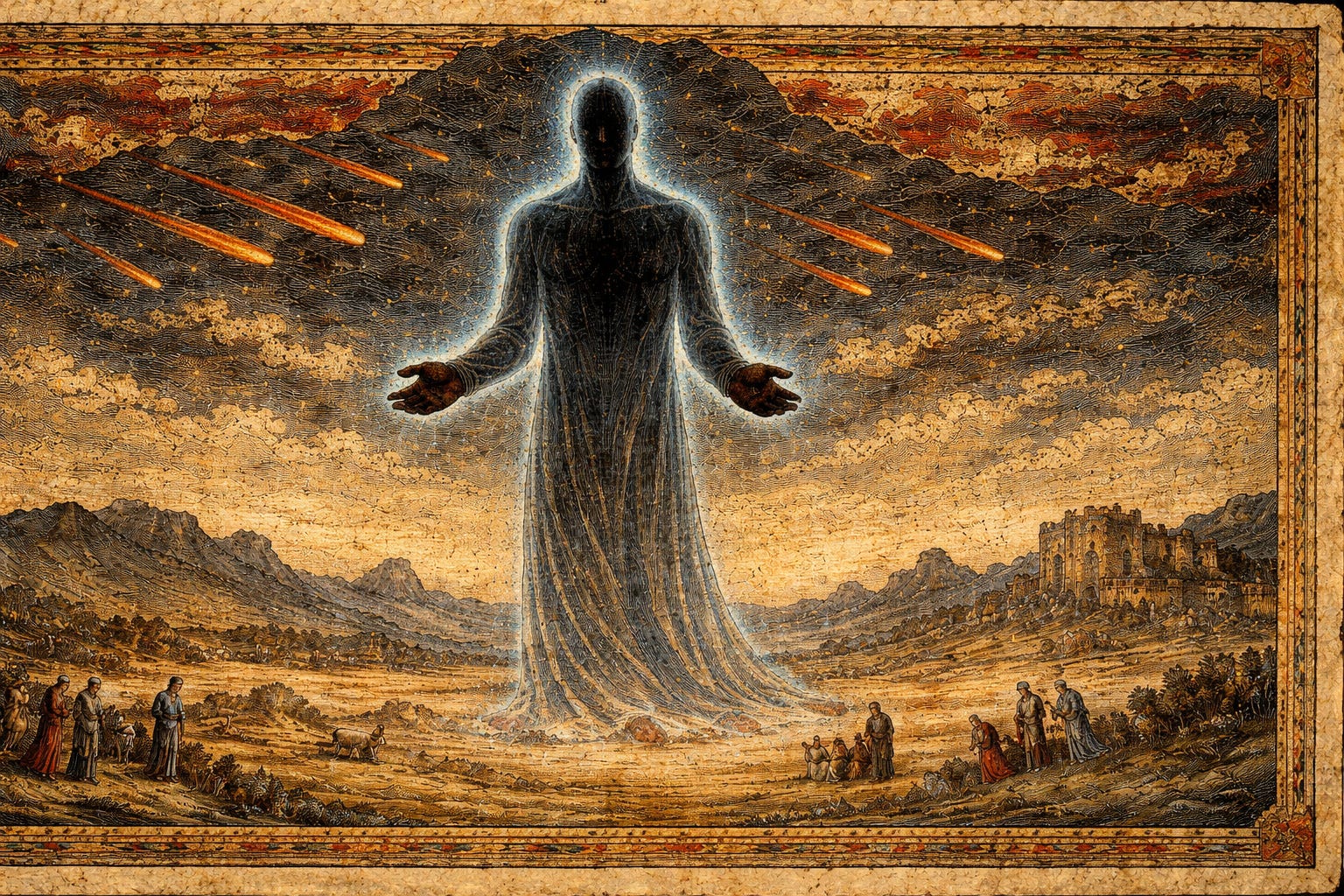
If you want to build a vampire mythology that holds up under pressure, don’t start with Stoker. Start with Enoch.
I’ve been building the theological backbone of Vampires of Tucson for three years. Along the way I read a lot of vampire mythology, source material, and folklore, trying to understand why most of it falls apart when you press on it. The answer is stark: most of it is borrowing from the same five sources, all of which are borrowing from each other, and nobody traced the chain back far enough to find the load-bearing architecture.
The load-bearing architecture is the Apocrypha. Specifically: 1 Enoch, 2 Enoch, 3 Enoch, the Books of Adam and Eve, the Book of Giants, the Testament of Solomon, the Testaments of the Twelve Patriarchs, the Apocalypse of Elijah, and the Ascension of Isaiah. These texts were produced between the 3rd century BCE and the 2nd century CE, circulated widely in early Christian and Jewish communities, and then systematically excluded from the canonical Bible between roughly the 4th and 7th centuries. The reasons are complicated and mostly political.
Post-exilic Judaism found them too Messianic. Emerging Christian orthodoxy found them too apocalyptic and too Jewish. Both built their vampire-explaining vocabulary from the curse of Cain and the demon-possessed corpse, and a thousand years of village folklore filled the rest. The Dead Sea Scrolls at Qumran survived because a sect in the desert didn’t get the memo from either council.
What’s in them is extraordinary.
The Third Kind of Being
The most important vampire-relevant passage in the entire corpus is 1 Enoch 15:8-12. God himself is speaking, explaining the ontological status of a category of being the text has just spent six chapters establishing: the Giants, offspring of the Watchers (fallen angels) and human women, who consumed all available food, then humans, then animals, and then “drank blood.”
When the Giants die, God explains what happens to their spirits. Their dwelling is in the earth and upon the earth, tied to the physical realm by the very flesh that produced them. They eat no food and nothing limits their movement. They corrupt without incurring judgment until the day of the great conclusion.
They are neither human souls nor fallen angels. They are a third, categorically new kind of being: one that fell outside every existing category of the divine order, constituted by blood-drinking in life and earth-bound by it at death, immortal until the end of the age.
The blood-drinking is not something that develops late in the narrative. It is constitutive to what they are: the text says they drank blood, full stop, and their posthumous spirits carry forward that defining property.
This is a cleaner ontological foundation for a vampire mythology than anything Stoker invented, anything Anne Rice invented, or anything the World of Darkness assembled over forty years of supplements. It has a mechanism. It has a category. And it has a built-in cosmological consequence: these beings will not be judged until the end of the age, which means they are structurally immortal, outside the normal machinery of divine accountability, for as long as history runs.
If you’re building a vampire mythology and haven’t read 1 Enoch, you’re working from second-generation copies of copies.
What Blood Actually Is
The Apocryphal corpus has a blood theology so sophisticated it makes most vampire fiction look like it’s working with a Fisher-Price cosmology.
In the Books of Adam and Eve, the first recorded sacrifice is Adam’s own blood, offered on an altar after he threw himself from a mountain. God accepts this and makes the first blood covenant, which runs forward through Abel, through the patriarchs, through every sacrifice in the Levitical system. Blood is the medium in which covenant is ratified. The circuit is one substance across all of human history.
Abel’s blood doesn’t just mark the first murder. It cries. The earth refuses to receive his body three times because he was righteous and killed without a cause, and righteous blood cannot be silenced by burial.
And then 1 Enoch 15 adds the complication: “you have defiled yourselves with women, and with the blood of the flesh begotten children, you have lusted with the blood of the people.” Blood is the marker of mortal flesh. To lust with blood is to choose mortality over immortality. The Watchers gave up their immortal nature for blood.
In a cosmology derived from the Apocrypha, a being that drinks blood is not merely feeding. It is drinking something that carries the weight of covenant and the voice of the dead, performing over and over the foundational transgression of the Watchers. The mythology doesn’t need to invent why blood matters. The Apocrypha already explained it.
Excommunicated from Life, Not from Grace
This is the piece of the Apocryphal framework that most directly shaped Vampires of Tucson.
In the Books of Adam and Eve, the Fall is not a destruction. Adam and Eve had what the text calls a “bright nature”: the same luminous, self-sufficient constitution as the angels. The Fall withdraws it, and God explains why flesh was then given: not as punishment, but as mercy, a buffer between the full darkness Adam deserved and the light he lost.
Applied to vampires, this means something specific. A vampire is a being from whom divine nourishment has been withdrawn, not destroyed. It is excommunicated from the mechanism by which the living receive light: cut off from the supply, not from the love. The darkness it experiences is not punishment but the natural consequence of interrupted connection.
The bright nature is still there, inside the flesh, slowly dimming. It can be maintained, barely. It cannot be recovered from the inside.
This is the distinction that makes tragedy possible in vampire fiction. A condemned creature has nowhere to go, but a creature excommunicated from Life but not from grace is in a condition of suspended waiting. It has been removed from the normal process, not written off.
The Natural Man
Here is the piece most vampire mythologies get wrong: they make the hunger evil.
The Apocrypha doesn’t. The Giants weren’t moral agents making wicked choices; the appetite was constitutive to what they were, not a decision they made. And 2 Enoch specifies that all souls are prepared before the formation of the world, which means the Giants were not outside the plan. They were a third kind of being, but they were still God’s third kind of being.
Across traditions, the same thing gets different names. The natural man in one register. The animal brain in another. Call it the demon in a third and you’re not wrong, though that word carries more baggage than the concept deserves.
It is not aligned with Satan. Satan is a being of will who knows exactly what he lost and keeps refusing it. The natural man doesn’t refuse anything. It just operates.
This matters for how you write a vampire who isn’t simply a monster. The Watchers chose deliberately, with full understanding of what they were violating. The Giants were what their nature made them. Struggling against your own constitution is not the same as choosing wrong, and the Apocrypha makes that distinction available to anyone willing to look for it.
The Waiting Covenant
The Books of Adam and Eve have one more structural gift for worldbuilders, and it’s the most counterintuitive one.
God cannot restore Adam before an appointed time. Not will not. Cannot. So God reframes the condition: suffering is the keeping-awake of the fallen being until the rescue arrives, and the waiting IS the covenant.
For a vampire mythology, this is useful in ways most worldbuilders miss. A being made at the moment of death carries a promise that cannot be fulfilled until a fixed but unknowable date. Its longevity is not punishment. Its endurance is the preparation.
In Vampires of Tucson, we call this Divine Suspension: the vampire is not damned, just paused. The door hasn’t closed. It’s stuck.
“God put your soul on hold and walked away for a few centuries” is, by any measure, a bleak way to describe your condition. The vampire who figures this out is not comforted. They’re furious. Which is the correct response.
Can They Be Redeemed?
The Apocrypha doesn’t answer this cleanly. The Giant-spirits “will corrupt without incurring judgment until the day of the great conclusion,” which means the judgment is deferred, not cancelled. The appointed time eventually arrives. What the judgment finds is whatever the being made of the waiting.
In VoT’s framework, Divine Suspension ends when the vampire re-dies. The interrupted process completes, and what the judgment finds is whatever the soul maintained or surrendered during the centuries between. A vampire at high humanity has kept the bright nature alive under conditions that would extinguish most things. The judgment resumes, and it doesn’t find the same thing every time.
The Apocrypha doesn’t promise redemption. It promises resolution. Those are different things, and the difference is where the drama lives.
The cruelest part: the vampire doesn’t know any of this. The common mythos tells them they are cursed and damned, hands them a verdict before the sentence even starts, and the texts that would say otherwise were suppressed fourteen centuries ago. They think the door is closed. It isn’t.
Some accept it; the descent that follows isn’t dramatic, just ennui and the slow cessation of pushing back until the slope does the rest. Others refuse the verdict without knowing why the refusal matters. The Apocrypha would tell them: it’s the whole point.
The Levitical Angle: Priesthood as Inheritance
This is where the framework gets specific in ways that go well beyond generic vampire mythology.
The pre-exilic Israelite religious structure, reconstructed from texts like the Testaments of the Twelve Patriarchs and the Book of Jubilees, included a household priesthood predating the formal temple system. This was priesthood inherited through bloodlines, practiced in domestic settings, organized around specific obligations: keeping appointed times, preparing consecrated foods, maintaining household altars. Not temple worship. Kitchen worship, running through families in a direct line.
If a vampire in your mythology carries that inherited obligation, the worldbuilding question isn’t whether the obligation transfers. It’s whether the obligation even cares.
In Vampires of Tucson, Abuela is a Cultural Levite, not a bloodline one. The culture was handed down mother to daughter for a very long time before it reached her, the practice surviving because women carried it forward, not because anyone remembered where it came from. She bakes twelve loaves of showbread every Thursday and feeds them to goats. She drinks the blood, tends the altar, prays without audible answer. She has done this for over a hundred years.
She doesn’t know she’s performing Temple rites. The meaning was stripped out somewhere in the maternal transmission, leaving only the form: twelve loaves, the goats, the blood, the altar. She is a devoted Catholic, and she would not take the news well.
Whether it does anything is, theologically, the most important unanswered question in the series.
What This Means for Your Mythology
You don’t have to use the Apocrypha the way I did. But if you’re building with vampires, or with any liminal creature that exists between life and death, between judgment and grace, you will find things in these texts that no other mythology is working from.
The third-kind-of-being ontology from 1 Enoch solves the classification problem. Your vampire doesn’t have to be a cautionary folk tale with teeth, or a ghost with an appetite. It is a specific category with a specific origin and specific cosmological properties.
The blood theology from the Books of Adam and Eve makes feeding matter in ways that extend into cosmic structure. You don’t have to invent the weight. It’s already there.
The bright-nature withdrawal gives you a vampire that is genuinely tragic. The horror is not the power. The horror is what’s missing.
And the waiting covenant gives you immortality with a purpose, or at least a purpose that has been suspended but not cancelled. The vampire isn’t just surviving. It’s holding something it cannot name, toward a completion it cannot see.
What they build together is the reason every other mythology eventually runs out of room.
That’s a mythology. Not a game mechanic, not a rule set, not a checklist of weaknesses. A mythology that answers the question the others don’t: why does it matter that this being exists.
The Apocrypha answered that question two thousand years ago. The vampire mythology industry just hasn’t found it yet.
You may also like: