The Survival Narratives
or: they don’t have the theology, but the theology has them

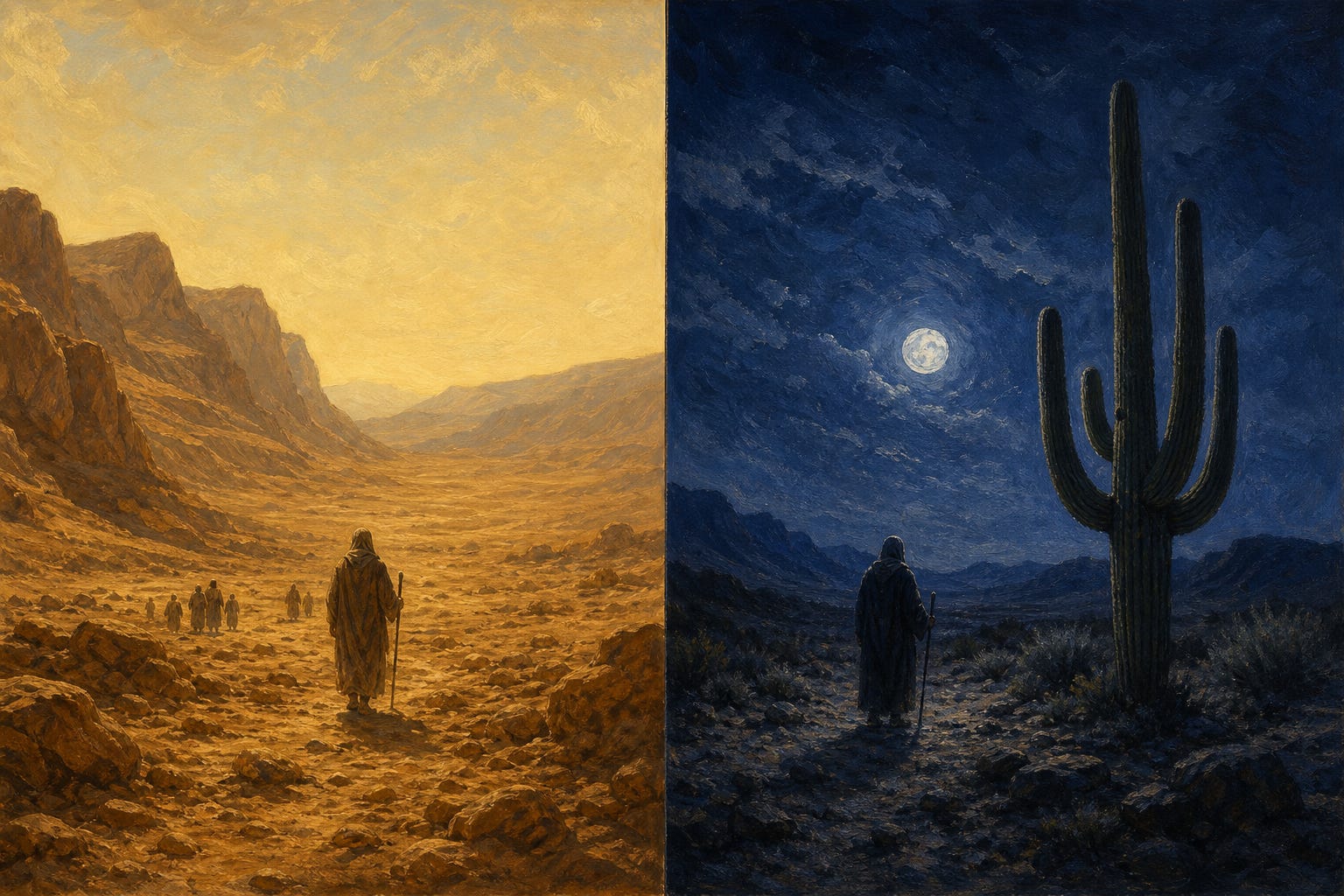
The last article in this thread handed the reader a map. The apocryphal corpus contains a coherent vampire theology (no, I am not claiming that Vampires exist), suppressed before Christianity finished drawing its canonical fence, and Vampires of Tucson is built on what is in it.
1 Enoch. The Books of Adam and Eve. The Book of Giants. The Testament of Solomon. A whole shelf the councils decided you were not allowed to read.
The reader walked out of that piece with the framework.
The vampires did not.
The texts that would explain their condition were buried fourteen centuries before any of them woke up in it. They reached for the inheritance they were promised, and the inheritance had been edited.
The mainstream theological canon that remained gave them nothing workable. Stoker. Folklore. A vague sense that the condition was a verdict. Whatever the village whispered.
So they built what they could. Eight worldviews emerged. None of them is true. All of them are load-bearing.
That is the asymmetry that drives the entire series. The author knows. The character does not. And the framework operating underneath the character’s worldview is still operating, regardless of which one they chose. The vampire is the one who does not know what they are. The theology is the one that knows them anyway.
This article is what the theology knows. And what the vampires do not.
The Suppression
The pre-exilic texts were the only surviving witnesses to what vampires actually are. They were not lost by accident. The Deuteronomic reformers in the seventh century BCE rebuilt the framework around the priesthood that benefited from rebuilding it, and the older material was relegated to the margins where time and political consensus could finish the job. The Council of Jamnia did its share on the Jewish side around the late first century CE. The Christian canon settled across the fourth through seventh centuries. By the time the Council of Trent put the lid on in 1546, the framework that explained the vampire was outside the fence on both sides.
There is no version of the suppression where the texts were misplaced; specific people did it, with specific reasons, mostly political, and the mythology industry has been working from the cleaned-up library ever since.
The vampire walks out of the grave with a theological inheritance built by editors who pre-decided what was allowed to be true about them. Cursed. Damned. Demonic. The thin gruel left after the actual framework was strained out. A category of being whose origin story was specifically deleted from the texts the surviving traditions would have read.
What is supposed to happen, given that vacuum, is what does happen. The vampire builds something to live by. Whatever local fragments they can stitch into a worldview that does not collapse the first time the silence answers. The construction is not a sign of weakness; it is what minds do when handed a condition the surrounding theology refuses to explain.
The construction is also wrong. Every version of it.
That is the load this article is asking you to carry: not that the survival narratives are foolish, but that they are necessary and they are also incorrect, and the truth pressing against them from underneath does not care which one the vampire picked.
The Vacuum Produces Survival Narratives
The Vampires of Tucson Master Lore Document (one of my worldbuilding texts) names the category correctly before listing any of its contents: “These are not doctrines, but survival narratives, stories the undead tell themselves to fill the interpretive vacuum created by suspended judgment.” That sentence is the entire frame. They are not theology. They are insulation against the silence.
Eight of them have settled into recognizable shapes across the series.
The Nihilistic position holds that nothing matters; the silence is absence, and meaning ended when the heartbeat did. The Hunger Doctrine says vampires are predators by design, that the appetite is the architecture, that the only honest theology is what the body demands. The Evolutionist reads the condition as ascension: the next step, the upgrade, the species selected by the inheritance the mortal world is too slow to recognize. The Punishment Theory reads it as sentence: divine wrath delivered, and the present existence as the serving of it.
The Accidental Model treats it as a cosmic glitch, a metaphysical error nobody intended, the universe momentarily forgetting itself. The Sovereign Model claims godhood: stripped of mortal limits, freed from mortal judgment, gods now. The Wanderer Philosophy says meaning is found only in motion, that the condition is a road, and the road is the point. The Reconciliationist senses something behind the silence that the others miss, an unnamed something the vampire cannot articulate but cannot stop reaching for.
The first thing to understand about this list is that the vampire does not hold these as hypotheses; they build their existence on them. Every feeding habit, every relationship, every moral calculation, every treatment of the mortal in front of them flows from the worldview underneath, and you cannot pull a load-bearing wall and expect the house to stand.
Which is why encountering the actual framework is not liberating. It is an earthquake.
The Punishment Theory is the longest slide from the most serious starting point. It correctly identifies divine involvement in the condition (something happened, and the something was not mechanical) and then misreads the category.
Suspension is not punishment. Extension is not sentence. The vampire arrived at “I’m damned, therefore nothing I do changes the outcome,” and that second step is the moral waterslide where the verdict justifies the abdication. The starting point was gravitas; the finish line is the same floor the Nihilist started on.
The difference is the trajectory. The Nihilist did not slide. They started at the bottom. The Punishment Theory vampire took longer to get there and was sober the whole time.
The Hunger Doctrine is a different failure. Blood, in the apocryphal framework, is the central operative substance: it carries covenant, it cries when it is spilled wrongly, it is what the Watchers chose in place of immortality.
The Hunger Doctrine correctly identifies blood as load-bearing. Then it categorizes it as prey-resource.
The Lore Document is precise about what just happened: they mistake consumption for communion. Blood is communion in the actual framework, inverted. Life given becomes life taken. To feed without conscience is sacrilege; to feed with awareness is penance.
The Hunger Doctrine vampire is performing an inverted sacrament while believing they are just eating; they have found the right theological category by accident and stripped it of every meaning that makes it the right one, and they are drowning in a theology they cannot read.
The Nihilist position is the cleanest case in the catalog. No slide. A trapdoor. They looked at the silence and concluded absence.
That was not the output of sustained reasoning. It was what happens when the silence is unbearable and the work of meaning is refused. The Nihilist did not arrive at nothing. They started there.
The Reconciliationist is a different problem entirely, and the one most worth writing carefully. They sense the actual truth without being able to name it: the instinct is correct, the articulation is impossible.
That proximity to the framework is the orientation closest to right, and it is also the most vulnerable; a vampire with correct instinct and no language is an open door, and anyone with a confident wrong answer can walk through it. Predatory elders. Cults. The other survival narratives, deployed with enough conviction to look like permission.
The Reconciliationist is the vampire most likely to be recruited into someone else’s worldview because they cannot defend their own; they know something is there but they cannot say what, and the one who arrives with a name for it wins.
The other four positions are not less consequential. The Evolutionist’s ascension story justifies cruelty as inheritance. The Accidental Model collapses moral weight by denying the design. The Sovereign Model is the Hollow Saints’ (really the only villains in the entire story) floor: gods now, and gods are not subject to the judgment they replaced. The Wanderer Philosophy is the orientation that produces the longest survival arc and the thinnest theology, motion as meaning, the road as the answer to a question the vampire never quite asks.
They are all load-bearing for someone. They are all wrong. And they are all sitting on top of the framework that does not need them to be true to keep working.
What Is Actually Operating
The framework the suppressed texts contain has shape. Not slogan-shape. Argument-shape. What follows is what is operating on the vampire whether the vampire ever finds out about it.
Begin with the creation. Genesis documents two of them. The first is spiritual: everything made in the spiritual realm before it was made in the physical one, the blueprint laid down before the materials were ordered. The second is the physical creation, built on top of the first, instantiating in matter what already existed in pattern. If the spiritual creation is the blueprint and the architect is the one who drew it, there are no cosmic glitches. Everything in the physical world has a spiritual antecedent.
The vampire exists in the physical world, and the vampire therefore exists in the spiritual blueprint; the category was permitted, or it was created, but it was not accidental.
The Accidental Model dies here, in the first move. There is no universe in which the condition is a glitch, and the condition has a place in the created order. What the vampire does inside the condition is open. The existence of the condition is not.
Move to the second piece. The vampire is excommunicated from life, not from grace, and that distinction is the framework’s central diagnostic on which the Punishment Theory founders.
The mortal community, the natural arc of mortal existence, the fellowship of the living, all of that is severed at the moment of the Turning, and the vampire cannot return to it. The door behind them is shut.
But grace is a different door, and it is not the one that closed. The divine feedback is silent. That is what Divine Suspension is.
Silence is not withdrawal. The access remains. The capacity for faithfulness is genuine. The possibility of moving toward light is real.
The Punishment Theory reads the silence as condemnation and concludes grace is gone. Both steps are wrong. The silence is suspension, not verdict; the verdict has not been delivered, the deliberation is paused, and what the vampire does during the pause is the verdict’s input, not its evidence in a closed case.
Third. The time is more runway, not more rope. A mortal has one lifetime to demonstrate who they are; a vampire has centuries, and the extension does not change the trajectory so much as amplify it.
The faithful mortal becomes a faithful elder; the slipping mortal becomes a fallen elder; the slipping mortal who refuses to acknowledge the slipping becomes the kind of vampire the genre is written about. The extra time is not a reward and not a punishment, but a longer line of sight from origin to outcome.
Fourth. Hell is self-constructed. This is where Charles Dickens did the framework’s work for it.
In A Christmas Carol, published in 1843, Jacob Marley appears to Scrooge wearing a chain. The chain is not placed on him by an external judge. He forged it in life. “I made it link by link, and yard by yard,” Marley says; “I girded it on of my own free will, and of my own free will I wore it.”
That is not metaphor. That is the cosmological statement. Marley arrived at the afterlife already bearing the architecture of his afterlife, and the chain was made of choices.
Every transaction he could have refused and did not. Every cruelty he could have softened and chose not to. Every act of recognition he could have extended to another person and withheld. The chain was him, externalized.
Scrooge’s hell, the one he is heading toward when the spirits intervene, is not fire and brimstone. It is the room he already lives in: the cold, the isolation, the dinner alone, the funeral nobody attends. He is building it one choice at a time.
The spirits show him the chain that has not yet been forged but is being assembled in his current movements. The intervention is not theological in the doctrinal sense. It is structural. They are showing him what is being built.
Dickens did not write an illustration; he wrote the actual cosmology, and hell is what the soul makes of itself when the slag is no longer being burned off.
The descent is not happening to the vampire. They are building it. Every choice to feed without conscience is another link, and every survival narrative that removes the friction is the rationalization Marley was making while forging the chains, link by link, yard by yard.
This is why the survival narratives matter beyond the vampire’s personal theology: they are the rationalizations that smooth the building.
The Punishment Theory says the chain is sentence, which is permission. The Hunger Doctrine says the feeding is design, which is choice. The Nihilist says nothing matters, by which the chain is being made of that very nothing. None of it is happening to them; all of it is them, externalizing.
Fifth. Grace cannot be earned, but it can be granted. The Master Lore Document carries that line, and it is doing more work than it looks like it is doing: if the vampire were cut off from grace entirely the sentence would mean nothing, and they are not cut off.
The vampire who maintains humanity is not simply resisting erosion through willpower; they are in active relationship with something that is still there, still present behind the silence, still measuring intent even when the feedback is gone. The granting is not theater. It is participation, conducted under the condition of suspended feedback. The participation counts, and whether the participant knows it counts is a separate question whose answer is usually no.
Sixth. The condition is the refining: one process, three images for the same theological move. The metallurgical image holds that the fire burns off the slag and leaves pure metal, while Israel’s forty years in the wilderness burned off what Egypt built and left what could cross into Canaan, the generation born to slavery unable to enter, the generation born to the desert able.
The desert itself, in the Master Lore Document’s appendix on the Ethic of the Damned, is “where God and the damned meet, not in light, but in truth. It strips away illusion. What remains is essence: need, will, and silence.”
Same move. Different image. The fire, the wilderness, the desert: all three are the same theological statement, which is that the condition is for the burning off of what should not have been carried.
Vampirism is the refining, extended. The trivial burns off first: the social performances, the noise of mortal life, the coping mechanisms built for a world the vampire no longer inhabits. What remains is whatever the person actually was underneath, and the pure metal has centuries to build toward light or toward darkness with no slag left to hide behind.
This is why the survival narratives are so urgently load-bearing: the Turning burns off the old slag, some vampires immediately build new slag over the pure metal, and the worldview becomes insulation against the refining the condition is already conducting.
The Punishment Theory vampire is the Israelite who concluded “God brought us out here to kill us,” saw the hardship, read abandonment, and missed the purpose entirely. The worldview does not just explain the condition; it covers what the condition exposed, and it slows the very process the vampire is in.
The Wanderer intuits that something is burning off without knowing what the fire is for, and the Reconciliationist is the Israelite who sensed Canaan existed even when they could not see it.
Seventh. The judgment is by works, not by genes and not by blood. Alignment with the divine naturally produces good works; the works are not the strategy but the evidence of the alignment, and if the vampire is moving toward the light, faithfulness happens and the equilibrium reflects the direction of travel.
The judgment, when it resumes, is on what was done at the point of decision. Not on what species the vampire was. Not on who their sire was. Not on what bloodline they inherited. Not on which survival narrative they adopted to explain the condition.
The condition is not the metric. What was done inside it is.
Or, as the Master Lore Document compresses it: vampirism does not change you. It reveals you.
The bright nature, inherited from Adam before the Fall withdrew it, is still there inside the vampire flesh, dimming or holding steady according to what the vampire keeps doing. The mortal lived a lifetime under the same architecture without the runway to reveal what they were; the vampire has centuries, and the reveal is the point.
The Five Modes piece in this series covered what cast-out characters do behaviorally; this piece covers what they believe about what they are. Different dimension, same population, and the modes and the narratives are not independent. A vampire in the Punishment Theory tends to land in Modes 1 or 3, while a vampire holding the Reconciliationist orientation is the most likely candidate for Modes 4 and 5. The worldview shapes the orientation, and the orientation shapes the chain, link by link, yard by yard.
The Craft Turn
Before you write the first scene a vampire character appears in, know which survival narrative they are standing on, because that is the load-bearing wall their entire behavior is built on. Their feeding habits, their relationships with mortals, their treatment of the rules they may or may not have inherited from a sire, their tolerance for the silence between feedings, all of it flows from the worldview underneath. Pick it before you write the want, because the want comes out of the worldview, and the worldview comes out of the vacuum the suppressed texts left behind.
Then know the actual framework operating beneath it. Not so the character can find it; they cannot, and most of them will go centuries without finding it. Know it so that you can write the gap between what is actually happening to them and what they believe is happening to them, because that gap is the engine of every scene a vampire of this make is in.
The asymmetry is the dramatic irony at the foundational level. The reader will not initially see the framework either; the reader will see the character’s worldview and read it as theology.
Then the scene comes that does not fit the worldview, and then another, and the framework is showing through. By the back half of the book, the reader is reading the worldview as worldview, not as truth, and the gap is open. They can see what the vampire cannot.
That is where the books live. Not in the answer the vampire arrives at. In the architecture they cannot see while standing inside it.
The author has the framework. The character has the load-bearing wall they built when the framework was buried fourteen centuries before they woke up needing it. The framework was operating the entire time anyway.
The vampire is the one who does not know. The theology is the one that knows them.
You write into that.
You may also like: